
Unsecured Business Loan No Property Security Explained
If you're looking for an unsecured business loan with no property behind it, you probably want two things: a realistic number and a straight answer on the catch. We'll give you both. This article covers how far unsecured lending stretches, what lenders look at when there's no real estate to take, and what you trade away in rate and risk.
Key takeaways
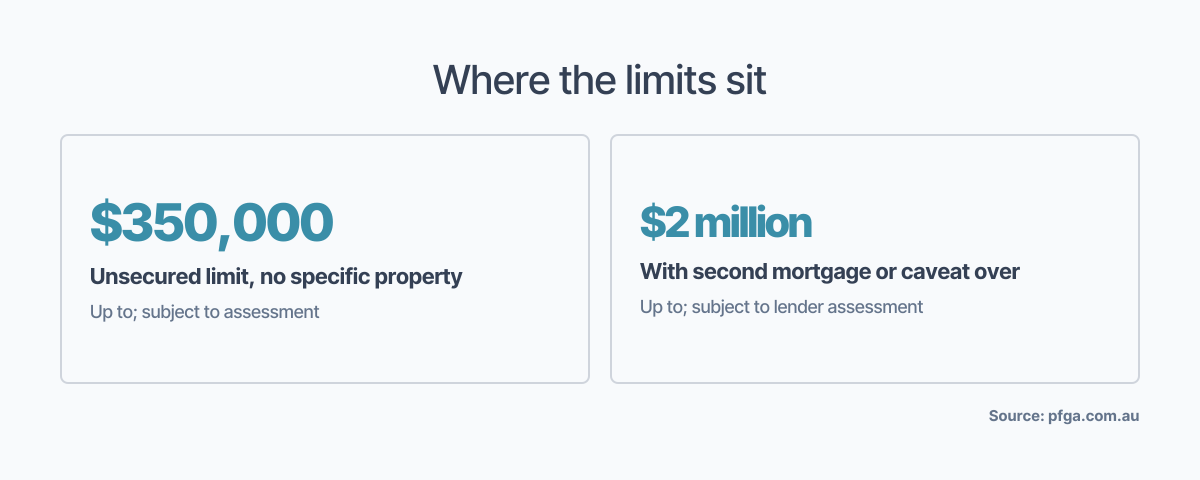
- PFGA's unsecured limit is up to $350,000, and limits up to $2 million may be available with second mortgage security or a caveat, subject to lender assessment.
- An unsecured loan pledges no specific property, but many still require a director's personal guarantee, so personal exposure can remain.
- A second mortgage ranks behind any existing mortgage, and a caveat is a notice on the title rather than a registered mortgage; either can put the property at risk.
- Without property to offer, lenders put more weight on cash flow and repayment conduct, and no lender can guarantee approval.
- Unsecured loans generally cost more, so compare total dollars over the full term, and check your borrowing capacity first to avoid a trail of credit enquiries.
It won't promise approval, and no honest broker can. Everything below is subject to lender assessment.
How much an unsecured business loan can realistically cover
Unsecured business finance in Australia has a ceiling. PFGA's unsecured limit is up to $350,000, and larger amounts may need property security, subject to assessment.
Within that ceiling, you don't pledge a specific property. Nothing is registered against your premises or your home, and the loan isn't tied to a title.
Lenders still look hard at the business itself. They assess cash flow, time trading, repayment conduct on existing debt and what the funds are for. Many unsecured loans also ask a director for a personal guarantee, which means the lender can pursue you personally if the company can't pay.
So "no property security" doesn't mean no security, and it doesn't mean no personal exposure.
Here's a hypothetical, not a real client. An owner needs funding that sits above the $350,000 unsecured ceiling. The business trades well, and the owner holds a property with some equity. Two paths are open: keep everything unsecured and accept a smaller raise than the project needs, or go for up to $2 million backed by a second mortgage or a caveat over that property.
The unsecured path keeps the property out of it. The cap limits what can be raised, though, and a guarantee may still reach the director personally. The property-backed path lifts the cap, but the lender now holds a claim on something the owner can lose.
It's tempting to assume the property route is the safer one because it may price lower. It lowers the lender's risk, but it moves that risk onto the owner's own balance sheet. Whether that's a good trade depends on how confidently the business can meet repayments, and that's a cash flow question before it's a property question.
What changes above $350,000, and when property security applies
Above the unsecured ceiling, a lender usually wants something to hold. Two common forms are a second mortgage and a caveat, and they aren't the same thing.
A second mortgage ranks behind any existing mortgage on the same property. Say the property already carries a registered first mortgage. If the borrower defaults, the second lender is paid only after the first lender's debt is settled. That's why the equity left after existing debt matters so much.
A caveat is a notice lodged on the title. It isn't a registered mortgage, and its terms can differ from one. Either structure can put the property at risk if repayments stop.
Before you commit, weigh the property's equity, the debt already sitting against it and whether it's the family home. Then have a solicitor or conveyancer check the documents, because the position turns on the specific title.
Larger amounts also tend to draw more scrutiny. The US evidence illustrates the principle. A Federal Reserve speech notes that business loans between $100,000 and $1 million are generally not underwritten solely on the basis of credit scores, probably because lenders are reluctant to take on the risk of larger amounts without a traditional underwriting approach. That's a US observation, not an Australian figure. The principle still travels: more money means more questions.
Pricing differs between the two routes as well, which the last section covers.
Before choosing a structure, you need to know what the business can service from its cash flow. That number, not the size of your wish list, sets the realistic limit. We can compare unsecured and property-backed options against it before any formal application goes in, using lenders across banks, non-bank lenders, private financiers and specialist commercial providers.
Eligibility for a business loan without security
Unsecured lending criteria turn on five things: cash flow, time trading, repayment conduct on existing debt, the purpose of the funds and the directors' credit position. Each lender weights them differently. Banks, non-bank lenders and private financiers don't assess the same way, so a decline from one tells you little about the next.
If you're after a no asset business loan, the short answer is that a business with no property to offer can still be assessed. More weight falls on cash flow and conduct, though. Lenders can't lean on a title if the numbers wobble, so they look closely at whether the business can carry the repayments from its own income.
That works both ways. A strong cash flow can support a business loan without security, but a thin one isn't rescued by a clean credit file. And if your repayment history on existing debt is patchy, expect questions before any lender gets to the purpose of the loan.
A bank can be a sensible first conversation for some businesses, particularly if you already hold your accounts there. For many others, comparing lender criteria first is more useful. You learn which lenders suit your trading history and structure before you put an application on file, and that matters because each formal application can leave a mark.
We don't state minimum trading periods or score cut-offs here, because they vary by lender and product. Every outcome is subject to assessment, and no lender, and no broker, can guarantee approval.
Unsecured vs secured business loans: the rate and risk trade-off
Unsecured loans generally cost more than property-secured loans. The lender has less protection if repayments fail, and the price reflects that. The headline rate is only part of the picture, though. Total cost depends on fees, term and early-repayment conditions, so compare the full cost in dollars over the life of the loan.
Property-secured loans can add their own costs, including valuation, legal and registration fees. A caveat's terms can also differ from a registered mortgage, so don't assume the two are priced or structured alike.
| Unsecured | Property-secured (second mortgage or caveat) | |
|---|---|---|
| Security taken | No specific property; a director's personal guarantee is common | Second mortgage or caveat over property |
| PFGA's stated limit | Up to $350,000 | Up to $2 million, subject to lender assessment |
| What you put at risk | Business cash flow and, often, personal exposure through a guarantee | The property itself, plus any guarantee |
| Pricing, generally | Higher, because the lender has less protection | Generally lower than unsecured |
| Check before signing | Guarantee terms, fees, term, early-repayment conditions | Ranking against existing debt, caveat vs mortgage terms, valuation, legal and registration costs |
Private and non-bank lenders assess and price differently from banks, so compare them too. A higher rate from one lender can still cost less overall than a lower rate with heavier fees.
Applying to several lenders one after another is the slow, expensive way to find this out. Each formal application can leave a trail of credit enquiries on the business's and directors' files. Assessing your borrowing capacity first helps you approach the right lenders once.
If you're a qualified business owner weighing an unsecured or property-secured structure, talk with us about your borrowing capacity before any formal application goes in. We're a broker, not a lender: our job is to compare lenders for you, not to lend to you. This is general information, not a credit assessment.
Frequently asked questions
Can I get a business loan without security if I own no property?
Yes, a business with no property can still be assessed. Lenders put more weight on cash flow, time trading and repayment conduct. No lender can guarantee approval, and PFGA's unsecured limit is up to $350,000.
Does an unsecured business loan mean no personal guarantee?
Not necessarily. Many unsecured business loans still ask a director for a personal guarantee. That means no property security, but you can still be personally exposed if the business can't repay.
What's the difference between a second mortgage and a caveat?
A second mortgage is registered and ranks behind any existing mortgage on the same property. A caveat is a notice on the title rather than a registered mortgage, and its terms can differ. Either can put the property at risk if repayments stop, so have a solicitor or conveyancer check the documents.
Why do unsecured business loans cost more?
The lender has less protection if repayments fail, so unsecured loans generally cost more than property-secured ones. Compare the full cost in dollars across fees, term and early-repayment conditions, not just the headline rate.
Will applying to several lenders hurt my credit file?
Several formal applications can leave a trail of credit enquiries on the business's and directors' files. Assessing your borrowing capacity before you apply helps you approach suitable lenders once instead.