
How Much Can My Business Borrow? Understanding Capacity
Before you compare rates or fill in an application, it helps to know how much your business can borrow, because that figure decides which lenders and structures are worth your time.
Key takeaways
- A business's maximum loan is usually set by whichever of cash flow, serviceability, security or credit is tightest, not by its best year or its strongest asset.
- Lenders test serviceability at an assessment rate above the rate you would actually pay, so a loan that looks affordable at the headline rate can still fail.
- In the hypothetical café, $120,000 of annual cash flow, 1.5 times coverage and $24,000 of existing repayments produce a ceiling of roughly $215,000, however much home equity sits behind it.
- Moving to a seven-year term lifts that hypothetical ceiling to about $270,000, and a lender needing 1.25 times coverage would allow around $275,000.
- Checking capacity before applying avoids a run of credit enquiries, and any estimate is indicative rather than an approval.
Lenders don't guess at it. They run the same handful of tests in a set order, and once you know the order you can predict roughly where your own figure will land.
How lenders work out how much your business can borrow
A business's maximum loan is usually set by whichever factor is tightest, not by its best year or its strongest security. Cash flow, serviceability, security and credit each get tested, and each is applied under the individual lender's policy limits. A café with a record-breaking quarter and a freehold property behind it can still be capped by thin monthly cash flow.
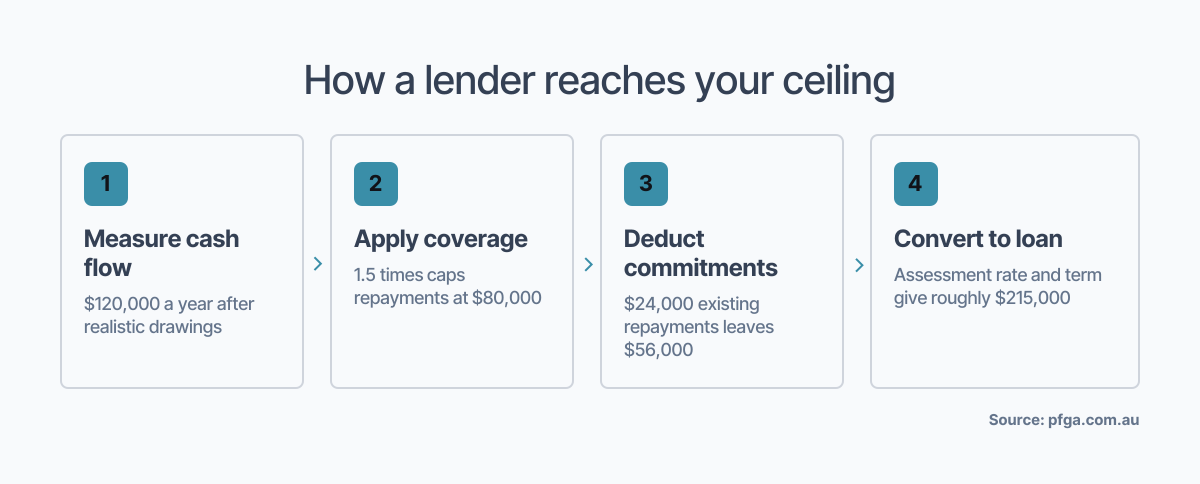
Here is how the four factors fit together.
| Factor | What the lender looks at | Effect on the figure |
|---|---|---|
| Cash flow | What the business generates after operating costs and a realistic owner's drawing | Sets the starting point |
| Serviceability | Whether that cash, after existing commitments, covers the new repayments at the assessment rate | Sets the repayment ceiling, and so the loan amount |
| Security | Assets or property that reduce the lender's loss if repayments fail | Usually caps the figure; rarely lifts it |
| Credit | Existing debts, guarantees and the directors' credit history | Reduces room for new borrowing; can narrow the lenders available |
Eligibility and capacity are separate questions
Eligibility is whether a lender will consider you at all. That usually means a minimum trading history, an active ABN and a credit standing above the lender's floor. Capacity is how much they will lend once you're through that door, and a business can be eligible with several lenders while having very different capacity with each.
Cash flow is the input
Lenders test cash flow against the trend in your financial statements, tax returns, business activity statements (BAS) and bank statements. A consistent pattern matters as much as your best recent result, so one strong quarter after two flat years won't carry the application. They also strip out a realistic owner's drawing, because a business that only looks profitable when the owner takes nothing home isn't generating the cash it appears to.
Serviceability is the test
Business loan serviceability asks whether the cash left after existing debts and commitments covers the proposed repayments, with the minimum coverage the lender requires. Lenders usually run that test at an assessment rate set above the rate you would actually pay. A loan that looks comfortable at the headline rate can therefore still fail, and you'll want to know that before you apply rather than after.
The lender then converts the repayment ceiling into a loan amount, using the proposed rate and term.
Security and credit usually cap the figure
Security is checked after repayment ability, and for good reason. It reduces the lender's loss if repayments fail, but it doesn't prove the business can make them, so strong asset or property security alone doesn't lift the amount your cash flow can support.
Business lenders typically register their interest over business assets on the Personal Property Securities Register (PPSR) and search it for existing registrations. If another financier already holds a claim over the same equipment, that can limit what a new lender will advance against it.
Credit works the same way. Existing debts, guarantees and a director's credit history all reduce the room left for new borrowing, and a past credit issue can narrow the lenders willing to consider the application at all.
Business loan eligibility factors in a hypothetical worked example
This is a hypothetical, not a client case, and every figure is indicative. Lender policies differ, so treat the numbers as a way to see the mechanics.
Take a café company planning a second-site fit-out. It's profitable but modest once the owners' drawings come out. It already carries equipment finance, and one co-director owns a home with plenty of equity. The company wants $300,000.
- Cash flow. After operating costs and a realistic owner's drawing, the business generates $120,000 a year before debt repayments.
- Coverage. The lender requires 1.5 times coverage, so total annual repayments can't exceed $80,000 (that is, $120,000 divided by 1.5).
- Existing commitments. The equipment finance costs $24,000 a year. That leaves $56,000 a year, or about $4,667 a month, for the new loan.
- Conversion. Assume a five-year term and an assessment rate of 11%. Each $100,000 borrowed then costs about $2,174 a month, so the ceiling is roughly $215,000.
At an actual rate of 9%, repayments on that $215,000 would be around $4,460 a month, comfortably inside the test. The assessment rate, not the charged rate, is what sets the amount.
The co-director's home equity doesn't change this. The lender could take that property as security, but the cash flow still supports only about $215,000, so the fit-out is $85,000 short.
Three levers can move the figure, and none guarantees a result:
- A longer term. Stretching to seven years at the same assessment rate lowers the repayment per $100,000 to about $1,712, lifting the ceiling to roughly $270,000, if the lender's policy allows that term for the purpose.
- Fewer existing commitments. If the equipment finance could be paid out, the full $80,000 would be available and the ceiling rises to roughly $305,000.
- A different lender. A lender that accepts 1.25 times coverage instead of 1.5 would allow about $275,000 on the original five-year terms, because total annual repayments could reach $96,000.
The third lever is why one answer is never the whole answer. This is not a promise that a lender will say yes at any of those figures. It shows which part of the position is doing the limiting.
What a business borrowing capacity calculator can and can't tell you
A repayment calculator takes a loan amount you type in and returns the repayments. That's useful for budgeting, but it works backwards from the question you're actually asking.
A capacity assessment runs the other way. It tests your cash flow, security and credit against lender policies to find a ceiling, so the loan amount is the output rather than the input. A business borrowing capacity calculator online can approximate that logic, but it can only apply one set of assumptions, and it won't see your PPSR position, your guarantees or how a particular lender treats your industry.
Lenders in the same market can apply different serviceability methods, minimum coverage levels and loan-to-value limits to the same business. One bank's answer is therefore a single data point rather than the full picture.
That's why we'd challenge the idea that walking into your bank is always the right first step. Your bank may well be the best fit, and nothing here says otherwise. But if it's the only lender you test, you won't know whether its ceiling is high, low or typical. A broker puts your numbers through several lenders' tests side by side, so you can see where your profile is strongest.
Each formal application can also leave a credit enquiry on file. Sending several in quick succession to find out who will lend is the expensive way to learn your capacity.
Estimate your maximum business loan amount before you apply
Your maximum business loan amount depends on documents that already exist, so most of the work is gathering them. Having them ready before the first conversation lets an assessment rest on your real position instead of rough recollection.
You'll want:
- financial statements, usually for the last two years
- business and personal tax returns
- recent BAS lodgements
- business bank statements
- a list of existing debts, leases and guarantees, with balances and repayments
- details of assets that could be offered as security, including anything already registered on the PPSR
From there, an indicative assessment compares your position across several lenders and structures before any formal application goes in. Fees and total cost get weighed alongside capacity, because the largest approved amount isn't automatically the best deal. A slightly lower loan on a better structure can cost less over its life.
We start by understanding your financial position, your funding objectives and what you need to borrow, and only then look at potentially suitable lenders. That order is deliberate: you should understand your borrowing potential before you submit anything.
If you'd like to see where you stand, you can request a personalised borrowing capacity assessment with us. It's indicative only, so it isn't a credit approval and it doesn't bind any lender. Outcomes depend on the lender and are not guaranteed, but you'll know your realistic range and your options before a single enquiry lands on your file.
Frequently asked questions
What's the maximum business loan you can get?
There's no single maximum. The ceiling is whatever your cash flow can service after existing commitments, tested at the lender's assessment rate and coverage requirement, then capped by security and credit. Two lenders can give the same business quite different figures.
What do you need to get a business loan in Australia?
Lenders generally look for an active ABN, a minimum trading history and acceptable credit standing, plus financial statements, tax returns, BAS and bank statements. Details of existing debts, guarantees and any assets offered as security are also needed. Exact requirements differ by lender and product.
What are the current interest rates for business loans?
Rates differ by lender, product, term, security and the strength of the borrower's profile, so no single rate applies to every business. Compare the rate alongside fees and total cost, and remember lenders assess serviceability at a higher rate than the one charged.
Will home equity increase how much my business can borrow?
Not by itself. Property security reduces the lender's loss if repayments fail, but it doesn't show the business can make those repayments. If cash flow is the tightest factor, the equity won't lift the amount.
Does checking my borrowing capacity affect my credit file?
An indicative capacity assessment before any formal application doesn't involve lodging applications with lenders. Each formal application can leave a credit enquiry on file, so assessing first avoids a run of enquiries. The result is indicative, not a credit approval.