
Commercial Property Refinance Broker: Why Use One
Refinancing a commercial asset isn't like adjusting a residential mortgage, yet many business owners approach the process with expectations set by consumer lending. The Australian commercial finance market in 2026 is fragmented. Lenders vary widely in how they assess risk, value security and price debt across different sectors and geographies. Relying solely on an incumbent bank for a commercial property refinance often means accepting that institution's current internal appetite rather than testing the broader market. We work differently: a specialist commercial property refinance broker accesses diverse lender panels to structure debt around your specific cash flow and asset profile, instead of forcing your business into a standardised credit policy.
Key takeaways
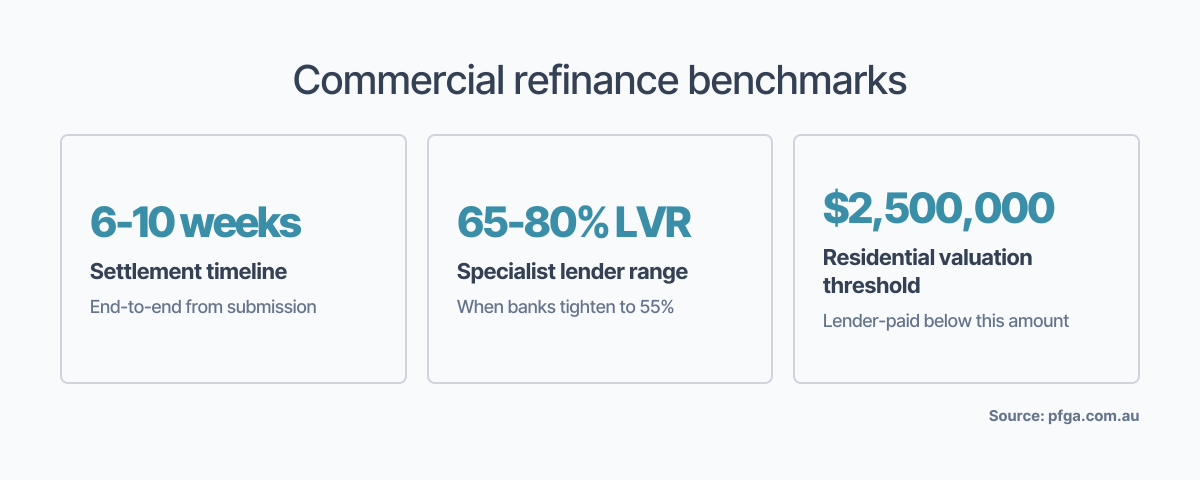
- Access to over 30 lenders enables brokers to source commercial refinance options at 65-80% LVR when major banks tighten sector policies to 55%.
- Commercial refinance settlement typically takes 6-10 weeks end-to-end, with 3-6 weeks required from submission to formal approval.
- Borrowers typically pay for commercial property valuations, unlike residential valuations under $2,500,000 which lenders usually cover.
- Maximum LVR's for commercial purchases sits between 60 and 80% through mainstream channels, with higher ratios available where supporting security is available.
- Assessing borrowing capacity before applying prevents multiple credit enquiries that signal distress to subsequent lenders.
How a Commercial Property Refinance Broker Secures Better Outcomes Than a Single Bank
Approaching your existing bank directly for a refinance seems logical. They already hold your financial history and understand your business operations. But that familiarity can become a constraint when internal credit policies shift, or when sector specific risk weightings change. Your relationship manager may advocate for you, but they can't override institutional mandates that have tightened since your original loan was written. A direct approach often yields a single data point rather than the competitive tension that drives better terms.
Consider a hypothetical but representative scenario: an Australian SME owner wants to refinance a commercial mortgage on a mixed use industrial property in late 2026. Their existing major bank has recently adjusted its internal risk parameters for industrial assets in that specific postcode, reducing maximum loan-to-value ratios and lifting margins over perceived oversupply in the local market. When the business owner approaches the bank for a refinance to release equity for expansion, the bank offers a reduced LVR of 55% with a higher interest margin, citing updated sector policy. The business now faces a shortfall against its funding requirement, and must either inject additional equity or shelve its growth plans.
A commercial property refinance broker solves this exact problem. With access to more than 30 lenders, we can source competitive options beyond major bank panels (Mint Equity). Rather than accepting the incumbent's constrained position, we identify non-bank lenders and specialist commercial funders who assess the same asset through a different lens, some weighing rental yield strength, tenant covenant quality or long-term zoning potential rather than short-term supply metrics. In this scenario, a specialist funder might offer settlement at 65-80% LVR on 3-5 year terms, matching the business's actual serviceability and growth timeline (Soren Financial).
This outcome shows that brokers don't simply find lower rates. We restructure debt to match operational reality. Major banks excel at vanilla transactions, where the borrower fits neatly within automated servicing models and standard security criteria. They're less equipped to handle nuanced situations: income verification that needs interpretation, security involving specialised assets, or timing pressures that demand settlement outside standard processing windows. Private credit and non-bank lenders fill these gaps with flexibility that regulated institutions can't structurally provide, though typically at a premium reflecting their risk appetite and cost of capital.
You benefit from this multi-lender strategy because it turns refinancing from a binary approval decision into a structured comparison of viable alternatives. Access to private credit becomes particularly valuable for time-critical transactions that major banks can't service within standard timelines, such as settling a purchase against a short deadline or refinancing away from a defaulting lender. Our role extends beyond rate shopping to identifying which lender's credit policy actually aligns with your circumstances right now, not which lender offered the best deal eighteen months ago.
Informed borrowing decisions start with understanding your options across diverse lender panels, not with accepting the first offer from an incumbent bank. This protects you from discovering your bank's constraints only after you've committed to a refinancing timeline and possibly incurred valuation costs. It also avoids the unnecessary credit enquiries that pile up when business owners apply sequentially to multiple lenders, hoping one says yes. We run this market scan confidentially, presenting you with comparable structures before any formal application touches your credit file.
Typical Timelines and Costs for Commercial Mortgage Refinance in Australia
Commercial refinancing runs on longer timeframes than residential lending, and planning around that reality prevents costly misalignment with lease renewals, contract settlements or tax deadlines. The typical timeline from submission to formal approval is 3-6 weeks, with 6-10 weeks to settlement a realistic end-to-end window for most transactions (Soren Financial). Complex transactions involving multiple securities, cross-collateralisation or specialist valuations can run longer, which is why early engagement matters when timing is tight.
Valuation costs are one difference between commercial and residential refinancing that catches some borrowers off guard. Lenders typically cover residential property valuations under $2,500,000 as part of their own acquisition cost. Commercial assessments, by contrast, remain a borrower expense in most cases (Mint Equity). Commercial valuations need more detailed analysis: rental comparables, tenancy schedule review, environmental considerations and highest-and-best-use assessment. That depth is what justifies fees that commonly run to several thousand dollars depending on asset complexity and location. Knowing this upfront lets you budget accurately and avoid surprises mid-application.
Loan tenor is another structural parameter where commercial products differ from residential mortgages. According to Mint Equity, commercial real estate loan tenors can extend up to 18 years in certain circumstances, which gives repayment flexibility distinct from residential products that typically cap at 30 years with stricter amortisation requirements. Shorter tenors of 3-5 years remain common for non-bank and private credit facilities, reflecting those lenders' capital recycling preferences and risk horizons. Matching tenor to your business plan and exit strategy matters more than chasing the longest possible term, since prepayment penalties and break costs can erode refinancing benefits if you repay early.
Business property refinancing rates vary considerably based on asset type, location, borrower strength and lender category, which makes published headline rates a poor guide to what you'll actually achieve. Major banks typically offer lower margins to prime borrowers with strong security positions, while non-bank lenders price for flexibility and speed rather than lowest absolute cost. Switching commercial property lender means weighing these trade-offs explicitly. A slightly higher rate from a non-bank can still deliver a better outcome if it gets you the LVR, tenor or settlement timeline your situation demands. Focusing only on interest rate ignores the structural features that often determine whether a refinance actually does what you need it to.
This process doesn't guarantee approval or specific terms, regardless of broker involvement or lender choice. Commercial lending stays discretionary, and even well-structured applications can be declined for reasons outside the borrower's control: lender balance sheet constraints, regulatory changes, shifts in sector appetite. Professional broking improves your odds of finding suitable finance by matching your transaction to appropriate lenders, but it can't eliminate credit risk assessment or override legitimate lending standards. Go into the process with that understanding rather than assuming a broker guarantees an outcome.
Assessing Borrowing Capacity Before You Switch Commercial Property Lender
Understanding your true borrowing capacity before you submit formal applications protects your credit file and preserves your negotiating leverage. Maximum loan-to-value for commercial purchases typically sits between 60 and 75%, though higher LVRs exist through specialist channels for borrowers with strong serviceability or extra security (Simplicity). Treat these thresholds as a starting point for conversation, not a fixed ceiling. Actual capacity depends on your income verification method, existing debt commitments, industry classification and asset quality. Testing this capacity informally with a broker lets you calibrate expectations before you commit to any lender's formal process.
Submitting multiple applications directly to lenders, hoping one sticks, creates visible credit enquiries that subsequent lenders read as a distress signal. Each decline compounds that perception, narrowing your options exactly when you need them most. A personalised borrowing capacity assessment identifies viable pathways before any application lodges, so you target lenders whose policies actually match your profile rather than hoping sequential applications pay off. This preparatory work is what separates strategic refinancing from reactive desperation.
We encourage you to seek a personalised assessment to explore both mainstream and alternative lending pathways suited to your financial position and funding objectives. This conversation costs nothing but time, yet it tells you whether refinancing makes sense given current market conditions, your asset's characteristics and your business trajectory. Getting guidance early replaces assumption with evidence, so you avoid wasted effort on transactions unlikely to settle, and it puts you in a position to move quickly when the right opportunity arrives instead of starting your prep under time pressure.
Frequently asked questions
Can I refinance commercial property if my bank has tightened LVR policy?
Yes, non-bank and specialist commercial lenders often maintain different risk appetites than major banks and may offer 65-80% LVR where incumbents have reduced exposure. A broker can identify lenders whose current credit policy aligns with your asset type and location without requiring you to submit multiple applications. This approach tests the broader market confidentially before any formal enquiry impacts your credit file.
How much will banks lend on commercial property in 2026?
Mainstream banks typically lend between 60 and 75% LVR for commercial property, though this varies significantly by asset type, location and sector risk weighting. Specialist and non-bank lenders may extend beyond 75% for borrowers with strong serviceability or additional security. Actual capacity depends on income verification, existing debts and asset quality rather than published maximums.
Who pays for commercial property valuations during refinancing?
Borrowers typically bear valuation costs for commercial property refinances, unlike residential loans under $2,500,000 where lenders often cover this expense. Commercial valuations require detailed analysis including rental comparables and tenancy reviews, justifying fees ranging from several thousand dollars. Budgeting for this cost upfront prevents mid-application surprises.
What is the typical timeframe for commercial mortgage refinance approval?
Formal approval typically takes 3-6 weeks from complete submission, with total settlement occurring within 6-10 weeks for standard transactions. Complex deals involving multiple securities or specialist valuations may extend beyond this window. Planning around these timeframes prevents misalignment with lease renewals, contract deadlines or other time-sensitive obligations.