
Business Vehicle Finance: Aligning Loans With Cash Flow
Business vehicle finance is a cash flow exercise, not just an asset purchase. Most business owners fix on the advertised interest rate or the monthly repayment figure, but those numbers rarely reflect what it's like to run a trade or service business day to day. A low rate means little if the repayment schedule pushes you into overdraft during your quiet season. A cheap car loan can turn into expensive debt if it locks up working capital exactly when you need it.
Key Takeaways
- Aligning vehicle loan repayments with seasonal revenue cycles prevents cash flow stress during quieter trading periods and preserves working capital.
- Accurate 12-month cash flow projections are essential for determining sustainable borrowing capacity rather than relying solely on historical financial statements.
- Eligible green vehicle finance discounts of 0.5% per annum exist but require verification of specific vehicle classifications and lender criteria before application.
- Non-bank and specialist lenders often provide flexible assessment criteria for complex business structures that fall outside traditional bank serviceability models.
- Professional brokerage assessment helps identify suitable lending pathways without triggering multiple credit file enquiries that could limit future borrowing options.
The best finance structures are built around your revenue cycle and tax position, not the lender's default settings. That means looking past the brochure rate to see how loan term, residual value and repayment frequency actually interact with your bank balance across the year. Understanding your options and your borrowing capacity before you submit any application is what keeps the finance working for the business, rather than against it.
Aligning Business Vehicle Finance with Operational Cash Flow
Your repayment structure needs to fit the rhythm of your income. A rigid schedule creates friction the moment a seasonal downturn hits. Vehicle finance should stabilise your business, not add volatility to an already uneven trading year. When we assess borrowing capacity for clients, we look at whether the debt service actually holds up against their industry's pattern of earnings, not just the annual turnover figure.
That distinction matters because two businesses with identical annual revenue can have very different capacities to service debt, depending on when the money actually lands. You might generate $800,000 a year but collect sixty per cent of it between September and March, leaving the rest of the year tight for fixed commitments. A standard twelve-month amortisation treats every month as equal. For most Australian SMEs, it isn't.
Using 12-Month Projections to Determine Repayment Capacity
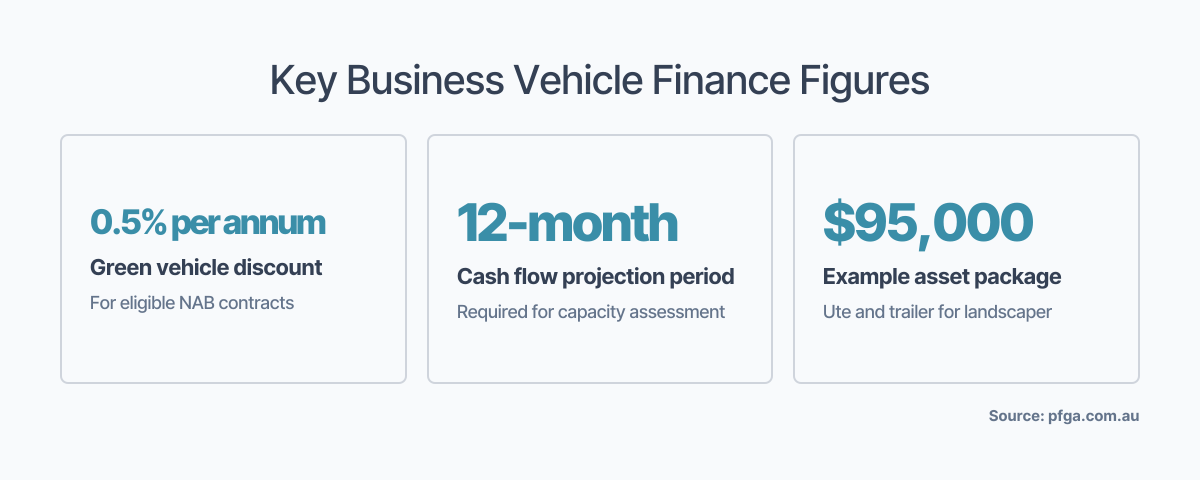
Good forecasting is what separates sustainable borrowing from over-leveraging, and it starts with monthly detail, not annual averages. According to CommBank's guidance on new business finance, accurate vehicle finance assessments rely on cash flow projections showing estimated income and expenses over a 12-month period, since that's what actually shows true repayment capacity. A forward-looking projection surfaces pressure points a historical P&L can't, which lets you structure the loan around what's coming rather than what's already happened.
Take a hypothetical landscaping company in Victoria financing a new ute and trailer package worth $95,000. The business earns well through spring and summer, then slows sharply in winter as outdoor work dries up and clients defer non-essential jobs. A standard five-year chattel mortgage with equal monthly repayments of roughly $1,650 would eat a disproportionate share of cash in June, July and August, possibly forcing the business onto overdraft just to make the payment.
Trade businesses with seasonal revenue often need repayment schedules built around their peak earning periods, not a flat monthly deduction, which is consistent with what we see across SME asset finance structuring at Sapphire Finance. For the landscaping business, that could mean higher repayments through the busy October-to-April stretch and reduced or interest-only payments over winter. A seasonal payment holiday, negotiated upfront, is another option. It gives the business room to breathe when revenue contracts naturally, without tripping default clauses or penalty fees.
Matching outflows to inflows this way protects working capital for wages, suppliers and the other variable costs that move with the season too. It turns the vehicle from a fixed burden into an asset that flexes with the business cycle. Any difference in total cost over the full term is usually small next to the value of avoiding a liquidity crunch that damages supplier relationships or forces a distress sale of other assets.
A broker's value here is finding lenders who offer real structural flexibility, not generic products built for salaried employees. We map your projected cash flow against the loan structures actually on offer to find the fit that supports growth without putting stability at risk. That level of customisation is rarely something you'll get through a direct bank application, where assessment is largely automated and standardised.
Structuring finance around cash flow doesn't guarantee approval, and it doesn't remove risk. Lenders still apply their own serviceability tests, and market conditions shift. What it does is cut the chance of default caused by timing mismatches rather than genuine insolvency. The aim is a facility that works quietly in the background, whether it's peak season or the dead of winter.
Incentives and Eligibility in the Current Market
Lender policy has a direct effect on your borrowing cost, and the right incentive can meaningfully change the economics of a vehicle purchase. Under the NAB Green Equipment Finance program, eligible borrowers may receive a 0.5% per annum discount on new qualifying green vehicle and equipment finance contracts. NAB states the discount applies under specific program terms, and over a five-year term on a $100,000 loan, that reduction can save thousands in interest while supporting your sustainability goals.
These discounts aren't a blanket entitlement across every electric or hybrid vehicle. Eligibility comes down to the specific vehicle classification, manufacturer certification and the lender's own definition of a qualifying green asset. Some programs exclude certain commercial vehicle categories or set emissions thresholds that differ from general government standards. Assume eligibility without checking it first, and you risk disappointment at settlement, or a repriced loan after approval.
Confirm whether your intended vehicle actually qualifies before you lock in a finance decision based on the discounted rate. Green finance applications often call for extra documentation or declarations about the asset's environmental credentials, which adds time to settlement. Build that administrative step into your procurement timeline, and it won't delay operations or put a purchase agreement at risk.
Some lenders also extend longer terms or higher loan-to-value ratios on eligible green assets to encourage uptake. Either structure can improve cash flow further, by spreading repayments over more time or cutting the required deposit. But both carry their own eligibility rules, and neither suits every business structure or tax position. A proper assessment is what separates a genuine benefit from a marketing claim that doesn't hold up once you look closer.
These incentives reflect a wider shift in Australian commercial lending towards sustainability-linked pricing. As more lenders move into this space, competition could drive further discounts or broader eligibility over the next year or two. Staying across current offers means you can take advantage when the terms line up with your fleet renewal plans.
Navigating Lender Options Beyond Major Banks
Business vehicle finance isn't limited to the major banks. Non-bank lenders and private financiers assess applications on different terms entirely. Banks tend to apply standardised serviceability models that favour steady monthly income and a long trading history, which can work against newer businesses or those with irregular revenue. Specialist commercial lenders often weigh contract pipelines, industry experience and asset security alongside the usual financial metrics, giving a more complete picture.
That flexibility matters when your circumstances sit outside mainstream lending criteria but the underlying business is sound. A transport operator with solid equity in existing vehicles but thin cash reserves might get funding through an asset-backed specialist, where a bank would knock the application back on liquidity ratios alone. A startup buying an established business with proven cash flows might qualify for acquisition finance through a non-bank lender willing to underwrite against post-acquisition projections rather than the standalone historical accounts.
Understanding your full range of options before you start submitting applications matters, because every application leaves a mark on your credit file. Each decline signals risk to the next lender, narrowing your options right when you need them most. Working with a broker lets you explore several lending pathways, compare structures and rates, and avoid adverse credit reporting until you've actually settled on the right option.
We help clients work through this by matching their financial position and funding goals to lenders whose appetite genuinely fits their profile. It saves time, protects your credit file, and often turns up solutions a direct applicant would never find on their own. The right lender for your situation isn't always the one with the lowest headline rate. It's the one whose assessment method actually recognises your business's real capacity to repay.
Getting a personalised assessment before you apply means you walk into the right lender with the strongest case from the start. That means having your financial documentation in order, your security position clear, and the commercial case for the finance laid out in terms lenders actually use. Preparation is what turns a speculative application into a proposal that holds up under credit committee scrutiny.
Frequently Asked Questions
How do I calculate my business's vehicle borrowing capacity?
Borrowing capacity depends on your 12-month cash flow projections showing estimated income and expenses, not just annual turnover. Lenders assess whether repayments fit within your revenue cycles, accounting for seasonal variations and existing debt commitments. A professional assessment maps your specific cash flow patterns against available loan structures to determine sustainable serviceability.
Can I get lower interest rates for electric or hybrid business vehicles?
Some lenders offer discounts of around 0.5% per annum for eligible green vehicles and equipment, but eligibility depends on specific vehicle classifications and lender criteria. These discounts are not automatic and require verification before application. Confirm your intended vehicle qualifies and factor in any additional documentation requirements that may affect settlement timelines.
Why would I use a non-bank lender instead of a major bank for vehicle finance?
Non-bank and specialist lenders often use more flexible assessment criteria that consider contract pipelines, industry expertise and asset security alongside traditional financial metrics. This suits businesses with irregular revenue profiles, newer trading histories or complex structures that fall outside standard bank serviceability models. They may approve applications where banks decline based on rigid automated assessments.
How does seasonal repayment structuring work for trade businesses?
Seasonal structuring matches higher repayments to peak earning periods and reduces or pauses payments during quieter months. This prevents cash flow stress when revenue naturally contracts without triggering default clauses. Lenders offering this flexibility tailor the schedule to your specific industry cycle rather than imposing standard monthly deductions year-round.