
Business Equity Release: Commercial Property Funding Guide
Equity release business funding means borrowing against the usable part of your commercial property's value, up to the lender's LVR cap, and only if the business can carry the repayments. It is how many owners unlock equity in business property without selling it, but the amount a lender will actually release is almost always lower than the equity you can see on paper.
Key takeaways
- Usable equity is lower than equity on paper because the lender applies its own valuation and maximum LVR, not your estimate, to set the total debt it will allow.
- Cash flow can cap a release below usable equity, because the lender tests whether the business can service the larger total debt.
- LVR caps and criteria vary by lender, property type, owner-occupied versus tenanted premises and loan purpose, so one lender's answer is only one view.
- A top-up, a split facility and a cash-out refinance each change what is available and what it costs, and a refinance may add break or discharge costs.
- The property is the security, personal guarantees may be required, and each formal application can leave a credit enquiry, so test borrowing capacity before applying.
How equity release on commercial property works to fund a business
First, a clarification. "Equity release" often brings retirement products to mind, such as reverse mortgages for older homeowners. This article is about something different: borrowing against a commercial property that your business owns or uses, to fund working capital or expansion.
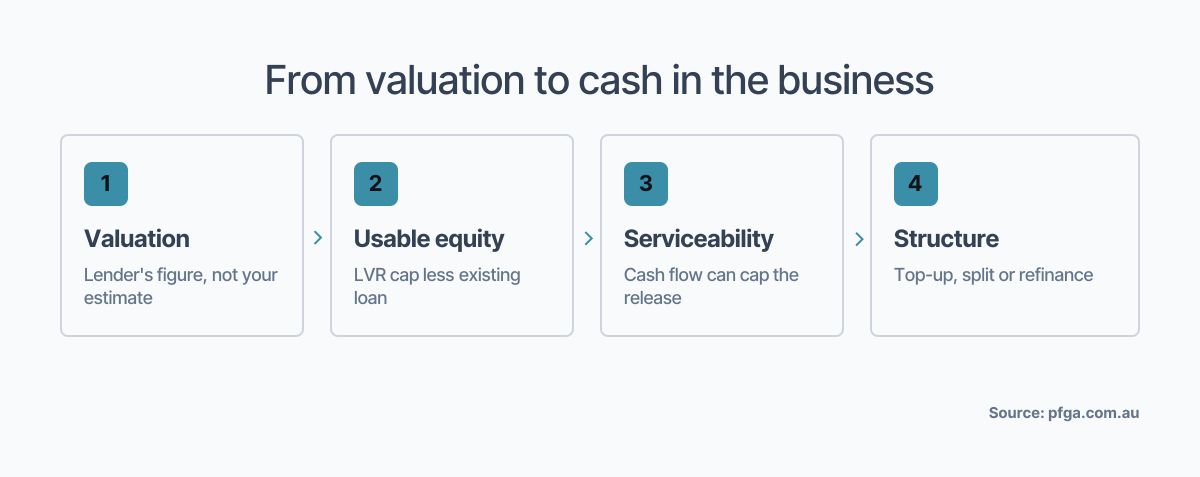
Three terms do most of the work here.
- Equity on paper is the property's value less the debt secured against it.
- LVR (loan-to-value ratio) is the loan expressed as a share of the property's value.
- Usable equity is the part of that paper equity a specific lender will actually lend against, after applying its LVR cap and its own valuation.
Lenders cap the total loan below full value as a buffer. If property prices soften or a sale is forced, the lender still wants to recover what it lent. Commercial caps are generally lower than the ones you may know from residential lending, and each lender sets its own. That is why no single figure can honestly be quoted here.
One point catches owners out. The LVR applies to the lender's valuation, not your estimate, and not what a neighbouring unit reportedly sold for. If the lender values the premises below your figure, every number that follows shrinks with it.
The property is only half the test. The lender also asks whether the business can service the total debt from its cash flow, and that test can cap the release below the usable equity the LVR would allow. A workshop with plenty of equity can still produce a modest release if recent profits are thin.
Owner-occupied and tenanted premises are read differently. When your business occupies the property, the lender mostly judges the loan on the business's own earnings. When the premises are leased to a tenant, the lender also looks at the lease, the rent and how strong the tenant is.
Equity release is not a way around weak trading. If the business cannot show it can carry the extra repayments, a large amount of paper equity will not change that answer.
Following one example from property value to cash in the business
The example below is hypothetical and illustrative. It shows the method, not an outcome, and it implies no approval for anyone.
Sam is an owner-operator who runs a light engineering business from a workshop owned by the trading company. The property has grown in value and the existing loan has reduced, so equity exists on paper. Sam wants to release some of it to fund a second production bay and its equipment. Here is the sequence a lender and broker would work through.
1. The lender's valuation. The lender orders its own valuation of the workshop. Sam's view of what it is worth is a starting point for conversation, nothing more. The valuer's figure becomes the base for everything below.
-
Existing debt and equity on paper. Take the lender's valuation and subtract the loan still owing. The remainder is Sam's equity on paper. It looks like the amount available, but it is not.
-
The LVR cap and usable equity. The lender applies its maximum LVR for this type of premises to the valuation. That gives the most total debt it will allow against the workshop. Subtract the existing loan from that ceiling and what remains is the usable equity. Because the cap sits below 100% of value, usable equity is smaller than the paper equity from step two.
4. The serviceability test. The lender then looks at recent business financials, such as trading results and existing commitments, to see whether the business can service the larger total debt. If the numbers are tight, the lender may approve less than the usable equity. In that case cash flow sets the ceiling, not the property.
5. The structure. Sam has three broad routes, and no single one suits every borrower:
- A top-up increases the existing loan with the same lender.
- A split adds a separate facility alongside the existing loan.
- A full refinance, often called a cash-out commercial property refinance, replaces the loan with a new lender. It can carry break or discharge costs on the old loan.
Staying put can be simpler and cheaper to set up. Moving can open a higher cap or a better rate. The right answer turns on the existing loan's terms and what each lender will do.
- What reaches the business. Valuation, legal, registration and lender fees come out of the process, along with any break costs if the loan is refinanced. What lands in the business account is the approved amount less those costs. Sam should plan the second bay around that net figure, not the headline one.
How LVR limits and lender criteria shape a commercial property equity loan
LVR caps and lending criteria are set lender by lender, which is why the same workshop can produce quite different answers. As at November 2026, these are the main variables we see in current practice.
| What varies | Why it changes the answer | What to ask a lender or broker |
|---|---|---|
| Property type | General-purpose office, retail or warehouse premises are usually assessed more readily than specialised assets such as childcare, hospitality or service stations, which may be assessed more conservatively or declined. | Is this property type within your policy, and does it change your maximum LVR? |
| Owner-occupied or tenanted | Owner-occupied premises lean on the business's own cash flow. Tenanted premises also depend on the lease, the rent and the tenant's strength. | Whose income do you assess, and how much weight does the lease carry? |
| Borrower profile | Trading history, business structure and director guarantees all feed into appetite and pricing. | How many years of trading do you want, and will you require guarantees? |
| Purpose and structure | Expansion equipment, working capital and debt consolidation are each read differently. | Does the stated purpose affect your cap, pricing or documentation? |
Purpose deserves a closer look. Money spent on equipment for a signed contract is usually easier to explain to a lender than money needed to cover slow months of operating costs. The second can prompt closer questions about the trading position, even when the property is identical.
Lender type matters too. Mainstream banks, non-bank lenders and private financiers often differ on LVR, trading history and pricing. In an illustrative case, two lenders assessing the same workshop might apply different caps and weigh cash flow differently, so one supports a larger release while the other declines the purpose altogether. That shows how criteria commonly vary, not what any borrower should expect.
A bank is often a sensible first conversation, particularly if your financials are well documented and you already have a relationship. But one lender's answer is one view of your property and business. A decline, or a smaller figure than you hoped for, from one lender does not rule out the market.
That is where we come in. We are a broker and adviser, not a lender. Before anything is lodged, we look at your financial position, your funding goal and the property, then compare how banks, non-bank lenders, private financiers and specialist commercial lenders are likely to treat them. You then see what your property and cash flow may support and which lenders are worth approaching.
This matters because each formal application can leave a credit enquiry on the business and director files. Informed decisions start with understanding your options and borrowing capacity, not with several applications sent in the hope that one lands.
Costs and risks to weigh before you release equity
Releasing equity turns a property you own into a larger debt, and you should weigh that plainly before going further.
The property is the security. If repayments are missed, the lender can take enforcement action against it, and in Sam's case that is the workshop the business operates from. Directors or owners may also be asked for personal guarantees, so you need to understand exactly how far any guarantee reaches before you sign.
Rates matter as well. Variable rates can rise during the life of the loan, and fixed-rate loans can carry break costs if you refinance early.
The headline rate is not the full cost. Valuation, legal, registration and lender fees all add up, and a cash-out refinance may add discharge costs on the loan being replaced.
Tax needs its own conversation. Interest deductibility generally follows how the borrowed money is used rather than what secures it, so confirm with your accountant before assuming a deduction.
A property held in a self-managed super fund faces strict borrowing rules that generally do not allow the fund's property to be used to fund your own business. Get specialist advice before you do anything in that situation.
Business-purpose loans also generally sit outside the consumer credit rules that apply to home loans. That means affordability checks rest more heavily on your own planning and advice. This is general information, not legal or tax advice.
If you own commercial property and want to know what business property equity finance could look like for you, we invite you to request a personalised borrowing capacity assessment before you submit any formal lender application. No approval, loan amount or outcome is guaranteed, but you will see what your property and cash flow may support and which lenders are worth approaching.
Frequently asked questions
What type of loan is best for releasing equity from commercial property?
No single structure is best for every borrower. A top-up with your current lender can be simpler, a split facility keeps the existing loan untouched, and a cash-out refinance may open a higher cap or different pricing but can add break or discharge costs. The right choice depends on your existing loan terms, what the funds are for and what each lender will support.
Can I use equity in my house to start a business?
Some lenders allow it, but that is residential borrowing, which is a different product with different rules and puts your home at risk. It is separate from releasing equity against commercial property, which this article covers. Speak to an adviser and your accountant before securing business funding against your home.
Will I need a personal guarantee to release equity from my business property?
You may be asked for one. Lenders often request guarantees from directors or owners, depending on the borrower's structure, trading history and the lender's policy. Ask for the scope of any guarantee in writing and understand it before you sign.
Can I release equity from property held in my SMSF to fund my business?
Generally no. A self-managed super fund faces strict borrowing rules that generally do not allow the fund's property to be used to fund your own business. Get specialist advice before taking any step.